Abstract
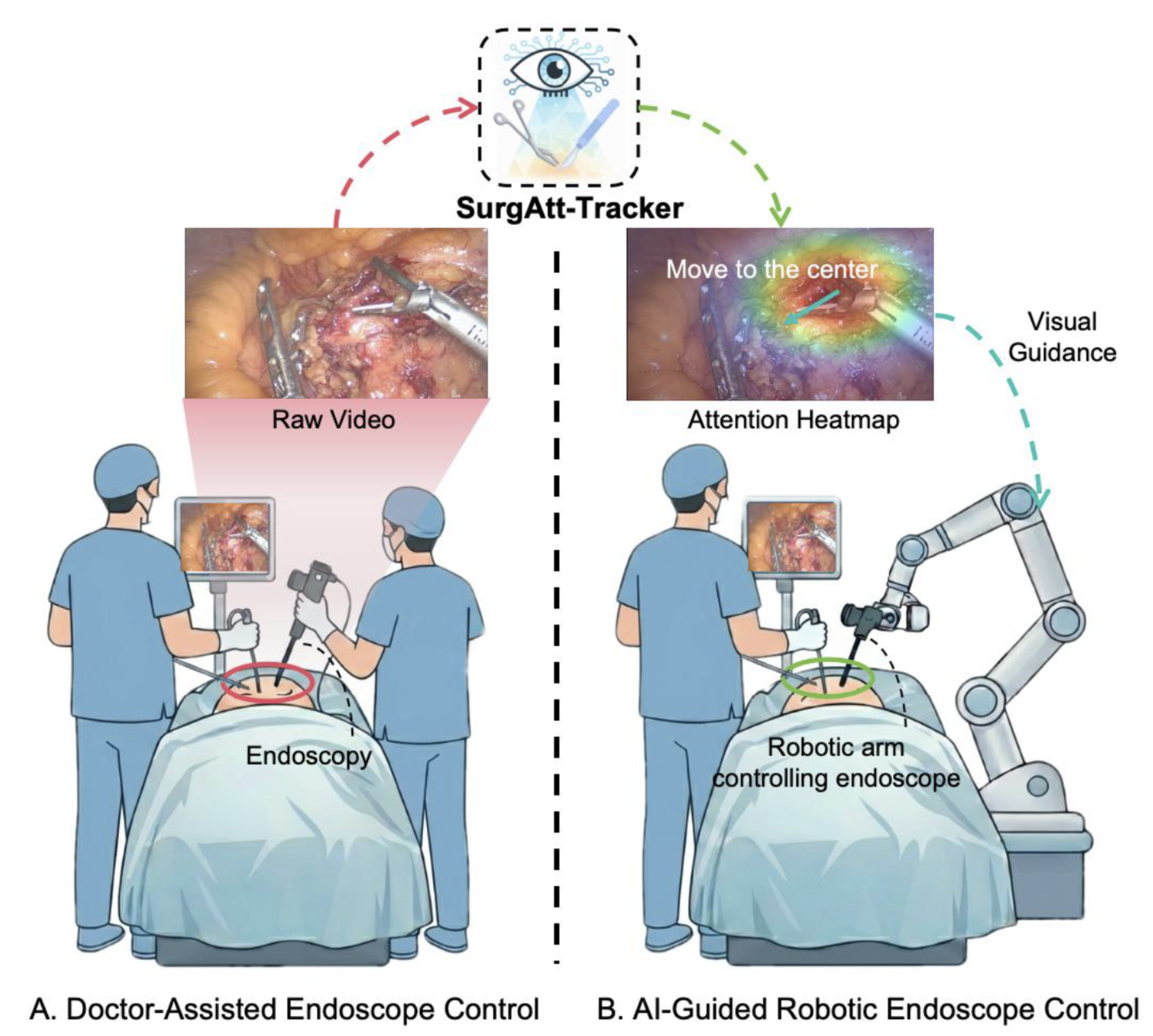
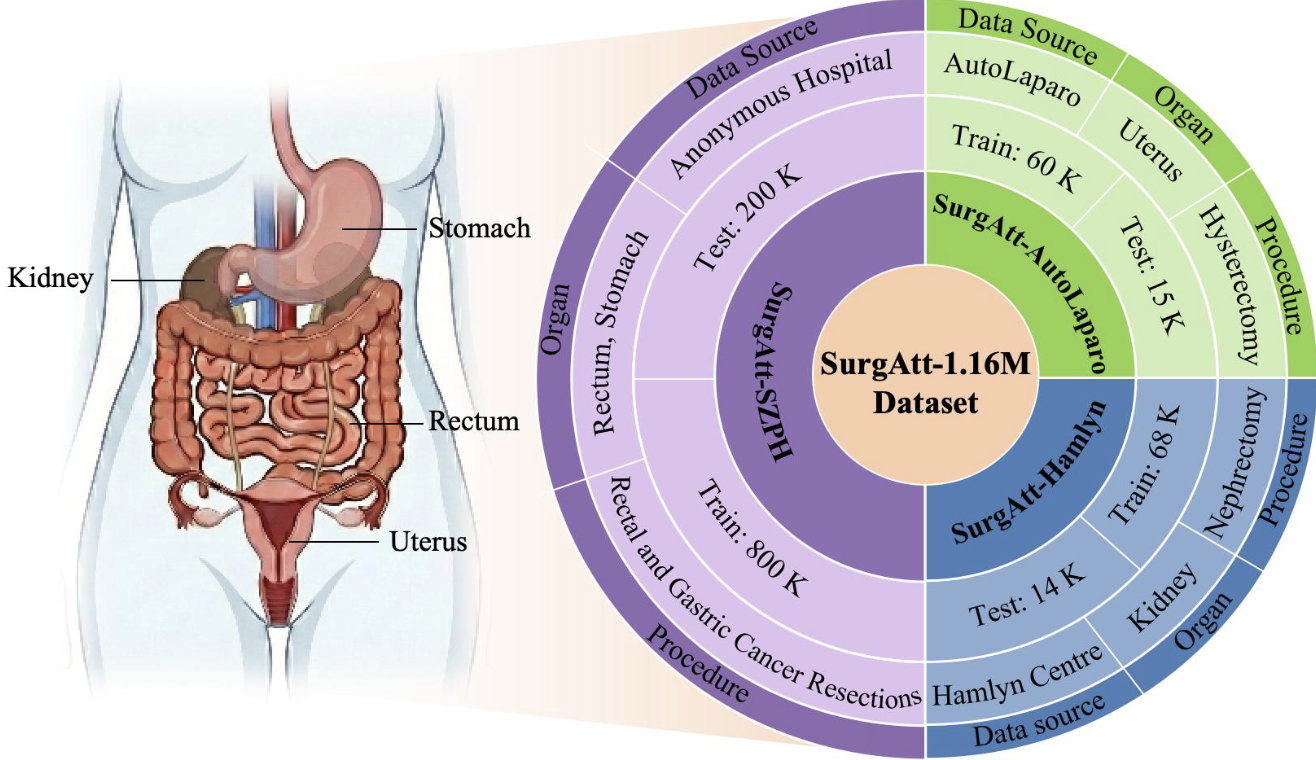
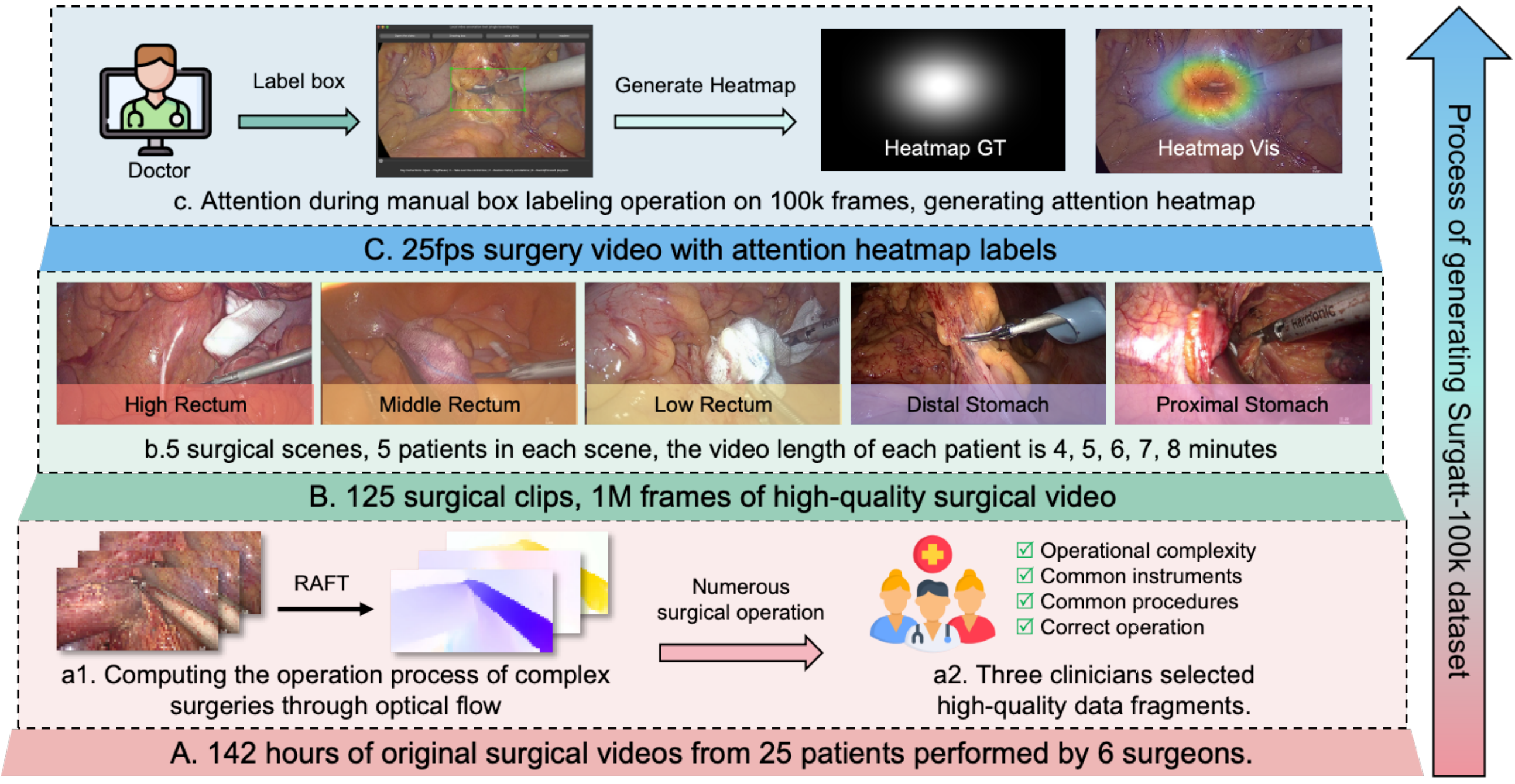
Accurate and stable field-of-view (FoV) guidance is critical for safe and efficient minimally invasive surgery, yet existing approaches often conflate visual attention estimation with downstream camera control or rely on direct object-centric assumptions. In this work, we formulate surgical attention tracking as a spatio-temporal learning problem and model surgeon focus as a dense attention heatmap, enabling continuous and interpretable frame-wise FoV guidance. We propose SurgAtt-Tracker, a holistic framework that robustly tracks surgical attention by exploiting temporal coherence through proposal-level reranking and motion-aware refinement, rather than direct regression. To support systematic training and evaluation, we introduce SurgAtt-1.16M, a large-scale benchmark with a clinically grounded annotation protocol that enables comprehensive heatmap-based attention analysis across procedures and institutions. Extensive experiments on multiple surgical datasets demonstrate that SurgAtt-Tracker consistently achieves state-of-the-art performance and strong robustness under occlusion, multi-instrument interference, and cross-domain settings. Beyond attention tracking, our approach provides a frame-wise FoV guidance signal that can directly support downstream robotic FoV planning and automatic camera control.
Surgical Attention Dataset: SurgAtt-1.16M
SurgAtt-SZPH Result
Qualitative comparison of attention heatmap predictions on SurgAtt-SZPH across five surgical scenarios. SurgAtt-Tracker produces sharper and more stable attention aligned with clinically relevant regions compared with representative SOTA baselines.
SurgAtt-Hamlyn Result
Qualitative comparison on SurgAtt-Hamlyn under zero-shot and fine-tuning settings. SurgAtt-Tracker shows more stable and better-localized attention than RT-DETRv2 and YOLOv12 across both regimes. (zs = zero-shot; ft = fine-tuning).
SurgAtt-AutoLaparo Result
Qualitative comparison on SurgAtt-AutoLaparo under zero-shot and fine-tuning settings. Our method maintains compact and consistent attention maps under domain shift and further improves after fine-tuning. (zs = zero-shot; ft = fine-tuning).
Licensing
The original dataset and annotations of SurgAtt-Tracker cannot be used for commercial purposes.